
Knowing and monitoring fuel usage and efficiency is important for several reasons. Fuel is the biggest expense on the loop. The amount of fuel we can carry and the speed at which we travel determines our range and therefore our routing, and changes in fuel efficiency can be a warning of potential mechanical problems such as problematic fuel, dirty filters, dirty hulls, etc.
Specification
Over Yonder has 2×100 gallon fuel tanks, a 6Kw Generator powered by a Kubota EA300 NB diesel engine, and a Volvo-Penta D6-370I-B BT (6 cylinder 370 Hp) diesel engine.
For determining range, the standard is to keep 1/3 of your fuel in reserve. I plan on keeping 60 gallons in reserve which give 140 gallons for use.
Diesel Generator
The diesel generator uses 1/3 GPH at half load and 2/3 GPH at full load. When staying on Anchor we need to run the generator for about 2 hrs every 2 days. That equates to about 3-4 gallons per week for the generator. We will plan for 5 gallon per week.
Diesel Engine
The diesel engine is the biggest consumer of fuel. The major factors impacting how much fuel is consumes by the diesel engine are winds, currents, and speed. Over Yonder is low to the water and present a low profile to the wind, and since the impact of wind is hard to quantify, we will ignore it. The next section describes the impact of current and speed on fuel consumption.
Definitions
There are usually 2 measures of speed on a boat. Speed thru the water (MPHKM), as read on a knot meter, and speed over the ground (MPHGPS), as read using GPS. Current is included in the MPHGPS measurement; current is not included in the MPHKM measurements.
Note; Current = MPHKM – MPHGPS
The MPHKM, as read on a knot meter, would have a better correlation with fuel consumption. However, MPHGPS, as read on our Tablets, phones, and chart plotters, has a better correlation with the distance and time we traveled. A positive current is a current in the same direction we are travelling and a negative current is a current opposing our travel.
We are able to measure RPM, GPH, MPHGPS and Current. (From this point MPH will be the speed over ground or GPS speed). We then use GPH and MPH to calculate the MPG.
Note; MPG = MPH / GPH
Data
We collected this data over several weeks. The following scatter plot presents the data.
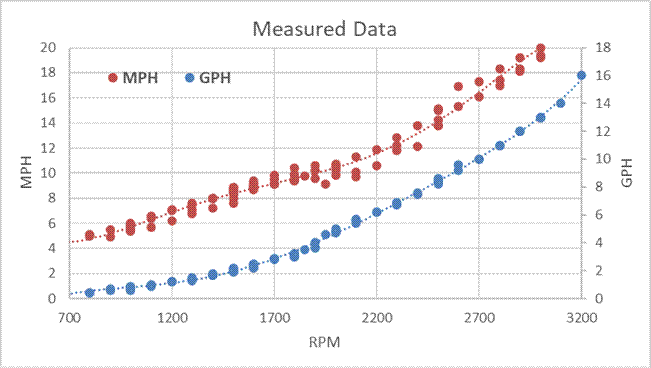
The relationship between RPM and GPH is relative consistent, while their relationship to MPH is not quite as regular though it does show a direct correlation between speed and fuel consumption.
Then using GPH and MPH to calculate the MPG. The following plot shows the relationship between MPH and MPG.
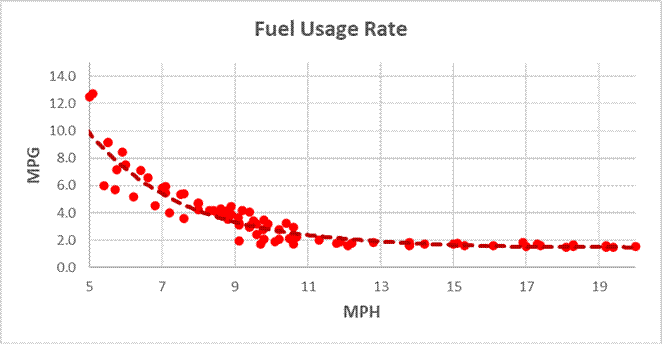
A few things to note:
- Below about 9MPH the relationship between MPG and MPH is almost linear (1 MPH increase in speed result is a 1.4 decrease in MPG)
- Above 12MPH the MPG is almost flat at about 1.7 MPG. This is probably the point where the boat is on plane. It is a Semi-displacement boat.
- The knee is between 9 to 12 MPH.
- As speed increase the relationship becomes more stable this is due to the fact that we did not see any data where the current was greater that 2Kts.
For example, consider the case where we are traveling at 6 kts on clear flat water. With a following 2kts current that would increases to 8 kts whereas with an opposing 2kts current it would decrease to 4 kts.
Trending
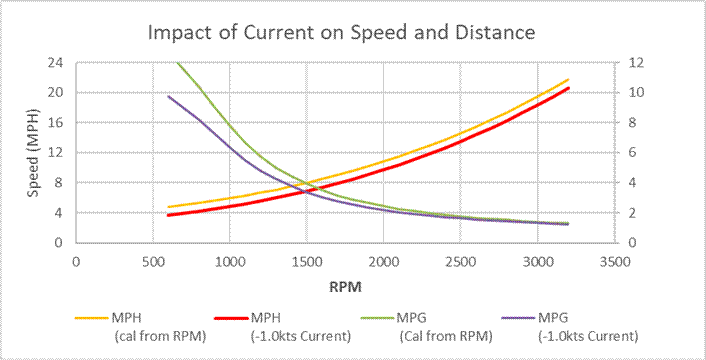
The trending analysis in excel was used to develop polynomial formulas relating RPM, GPH, MPH, MPG, and Current.
The Following shows the impact of current on Speed and Range using that trending.
Pulling It Together
We were able to put all this into a table to aid in our planning.
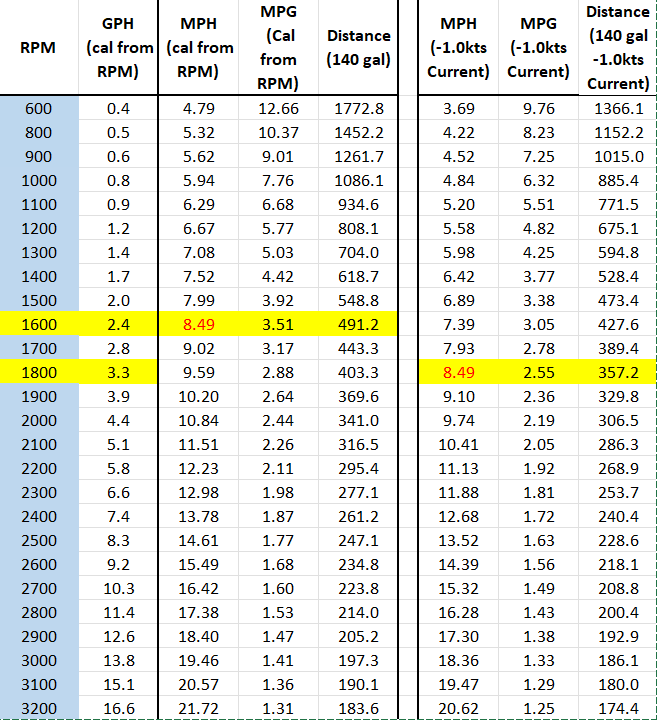
At 1600 RPM we should be able to make 8.5MPH, and using 60% of our fuel capacity our range would be 491 miles. If we had a 1 kts opposing current inorder to maintain 8.5MPH we would need to increase our RPM to 1800 and our range would drop to 357 miles.
One thing to note is that at 6MPH our range is ~1000 Miles while at 20MPH our range is ~200 Miles.
We can use the same table to calculate the range based on our reserves,60 gallons. In this case though we assumed that 10% of the fuel (6 gallons) was unusable. That leaves us with 54 gallons. At 1000 RPM we should be able to make 6MPH. That would give us a range of about 420 miles. If we had a 1 kts opposing current inorder to maintain 6MPH we would need to increase our RPM to 1300 and our range would drop to 230 miles. If we need to “out run a storm” we could increase our speed to 3000 RPM and 20MPH. Our range would be 76 miles. If we had a 1kts opposing current we could increases our speed to 3100 RPM and maintain 20 MPH but our range would drop to 70 miles.
Conclusion
Based on the above if we travel at ~8MPH for 5-6hrs in a day. At this rate we need to refuel ~ every 7-8 days or ~400 miles of travel.
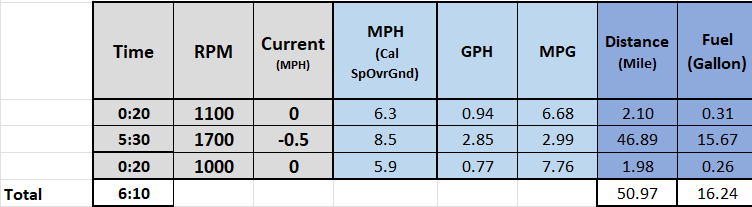
In actuality our average travel speed has been about 8.76MPH and we are refueling about ever 4-5 travel days (250 miles) and our average refill has been 52 gallons.